
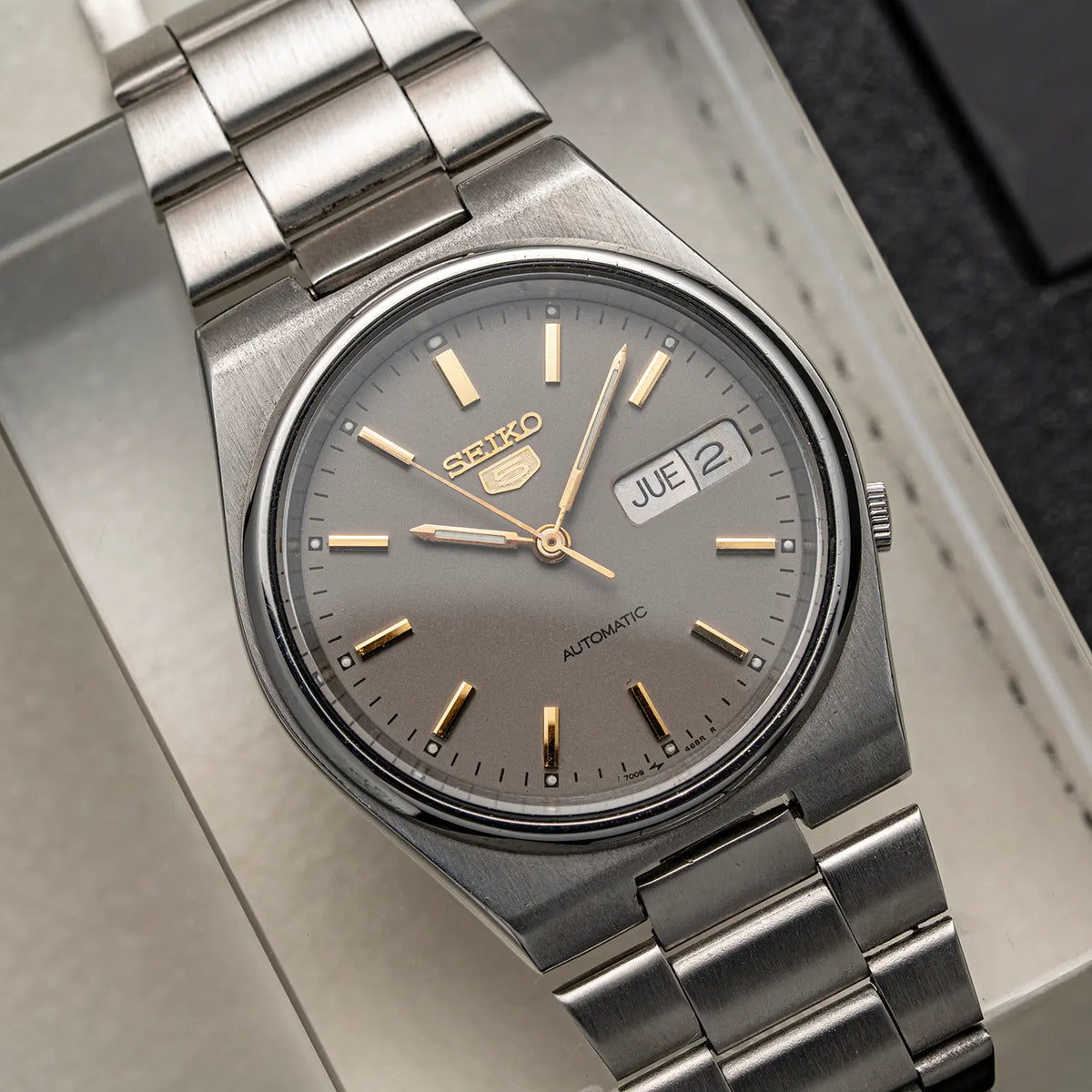
Vintage Seiko 5 Buying Guide
A good vintage Seiko 5 is not necessarily the cleanest-looking example or the one with the highest jewel count. It is the watch whose reference, dial, movement, condition and seller's description make sense together. A carefully documented 1980s automatic with honest wear may be a better purchase than a freshly polished watch with an uncertain dial or a calendar that no longer works correctly. This guide explains how to evaluate the actual watch before you buy—not just the Seiko 5 name on its dial.
What qualifies as a vintage Seiko 5?
Seiko introduced the Sportsmatic 5 in 1963. Its original concept combined automatic winding, a day-date indication, water resistance, a crown protected by its position and a durable case-and-bracelet design. Seiko 5 Sports followed in 1968 with a more overtly sporty character. Those are historical design intentions, not promises that a particular decades-old watch remains waterproof today. The family later encompassed many case shapes, movement generations and regional versions. A Seiko-branded vintage automatic is not automatically a Seiko 5: look for the actual model and dial identification, not merely a familiar caliber number.
Start with the vintage Seiko 5 collection to see how different watches can share the same practical automatic day-date idea without sharing a case, dial or period.
A buyer's inspection sequence: seven checks that matter
1. Identify the exact case reference and movement
Ask for a sharp caseback photograph. Many Seiko references pair a caliber designation with a case code—7009-3130, for example. The first portion usually identifies the movement family; the second helps distinguish the case design. Match that information against the dial, movement and listing. The serial number may help narrow the production period, but the decade cannot be established responsibly from a single year digit without reference context. Treat a date stated in a listing as a claim to be supported, not proof of originality.
The VWS Seiko 5 Ref. 7009-3130 is a useful documented example: its gallery includes a separate caseback photograph rather than expecting the buyer to rely on the dial alone.

2. Study the dial, hands and calendar up close
Examine the applied logo, outer minute track, printing spacing and alignment of hands with markers. A textured dial can be original; equally, a bright dial can be refinished. No single feature proves a redial. Look for inconsistencies among lettering, lume, hand style, minute markers and the specific reference, then compare against documented period examples. A replacement crystal is very different from an undisclosed replacement dial. Likewise, a bilingual day wheel may be correct for a market or individual watch, but its presence alone does not prove a special edition.
Consider the original-looking crosshatched dial on the 1984 Seiko 5 Ref. 7009-8750. Its fine texture illustrates why close photographs are more informative than a vague condition grade.

3. Inspect the case geometry—not just the shine
Heavy polishing can soften transitions between brushed and polished surfaces, round off corners and change the watch's character. Conversely, light scratches do not automatically make an untouched case inferior. Check both sides of the case, lug symmetry, bezel fit and crown area. A stainless-steel case and a plated case age differently; inspect the actual material noted for the reference. Missing edge definition is usually harder to reverse than routine crystal wear.
4. Measure how it will wear
Vintage Seiko 5 watches often sit below the diameter of modern sports watches, yet case shape changes the impression considerably. Diameter by itself is not enough. Ask for lug-to-lug length, thickness, lug width and bracelet sizing. In the VWS catalog, a 36 mm Seiko 5 7009-3130 measures about 41 mm lug to lug, while the 38 mm 6319-8100 measures about 42 mm. That one-millimeter difference in length helps explain why a broader case may remain wearable on a smaller wrist.

5. Check the movement and day-date operation
Do not assume all Seiko 5 calibers set the day and date identically. Different generations use different crown operations; some older examples use a crown-push action for part of the calendar. Follow verified instructions for the specific caliber and never force a reluctant corrector. In particular, avoid changing the quickset calendar while the mechanism may be engaged around midnight; move the hands to a safe daytime position before testing. Ask the seller to confirm that both day and date change properly and that the crown returns securely to its normal position.
Many familiar Seiko 5 automatics, including the 7009 and 7S26 generations, do not wind manually through the crown and do not stop the seconds hand for setting. Those normal features should not be mistaken for defects. For precise 7009 operation and construction, the published Seiko 7009 movement guide provides the movement-specific background.
6. Ask what 'serviced' and 'running well' mean
A watch ticking in a short video is not the same as a properly inspected movement. Ask when it was serviced, whether the calendar was tested, whether any worn parts remain and what timekeeping evidence exists. A single rate reading—say, in seconds per day—describes a particular test position and state of wind, not a lifetime guarantee. Amplitude, variation across positions, power reserve and dependable calendar change matter too, although not every seller can provide every measurement. Request clear disclosure rather than imaginary precision.
Vintage Watch Studio states that the mechanical watches it sells are serviced and supplied with a 12-month warranty. That should give a purchaser specific questions to ask about the individual watch, not replace reading its listing and warranty terms.
7. Inspect the back, bracelet and remaining components
Check caseback engravings and the movement photograph where offered. Confirm whether the bracelet is original, whether it fits your wrist, whether spare links are present and whether a replacement strap is openly identified. A later strap can be a perfectly sensible choice; an inaccurately described factory bracelet is a different issue. Caseback scratches, bent spring bars, poorly fitting end links or extensive corrosion deserve closer attention than a small superficial mark on the crystal.

How to compare the common Seiko 5 movement families
| Movement | What it means to a buyer | Most useful check |
|---|---|---|
| 6119 | Earlier Seiko 5 automatic generation; specific day-date operation varies by configuration | Check calendar corrector, movement condition and original dial |
| 6309 / 6319 | Broad range of 1970s–1980s day-date dress watches, not only diving watches | Verify case reference, condition and the watch's actual calendar mechanism |
| 7009 | Widely encountered automatic day-date family with no crown hand winding | Check day setting, dial and service evidence |
| 7S26 | Later automatic Seiko 5 generation, also without crown hand winding or hacking | Inspect condition, version and calendar setting |
None of these names guarantees a better watch. A well-maintained 6119 can be more rewarding than an abused 7S26, while a fully documented 7009 is easier to evaluate than a mystery assembly. If you are comparing early 6119 examples, consult the published Seiko 6119 guide rather than generalizing the setting method from later calibers.
Originality versus replacement: where to draw the line
For collectors, a correct dial, case, hands and reference relationship is usually more important than preserving a dried gasket or scratched crystal. Maintenance parts may be changed during responsible service. A refinished dial, mismatched hands, altered markings or an undisclosed swapped movement can change the object's identity and desirability. The sensible question is not whether absolutely every component is untouched; it is whether the seller accurately explains what is original and what has changed.
Also distinguish cosmetic aging from moisture damage. Gentle patina may be attractive, but spotting under the crystal, staining on the movement or corrosion around the crown can indicate more serious problems. If the listing offers no clear movement or caseback view, request one before paying.
Price, service costs and water resistance
Set a total budget rather than a purchase-price ceiling: watch, shipping, applicable import charges, strap or bracelet changes and any necessary servicing all count. Do not pay a 'rare vintage' premium merely because a seller prints an old year in the title. Compare like with like: reference, originality, case condition, documented servicing and included warranty. Historical list prices are not evidence of today's market value.
A decades-old water-resistance marking is not a diving invitation. Seiko explains that gasket aging and impacts can compromise a watch's original resistance. Unless this particular watch has been recently tested and explicitly cleared for the intended activity, keep it away from swimming and showering—even if the back says WATER RESISTANT.
The practical pre-purchase checklist
- Clear dial, caseback, crown-side and movement photographs, plus the reference and production-period rationale.
- Consistent hands, indices, calendar and case finish; any replacements clearly disclosed.
- Both calendar indications working and crown operation tested without force.
- Diameter, lug-to-lug, lug width and realistic bracelet fit supplied.
- Service statement, functional assessment, warranty terms and final landed cost understood.
A Seiko 5 becomes a strong purchase when those answers agree. Browse the broader vintage Seiko selection to compare different generations, but use the individual watch's photos and documented details as the final evidence.
Frequently asked questions
Is a vintage Seiko 5 a good first mechanical watch?
Often yes, particularly a straightforward, documented automatic day-date watch with a suitable case size and known service condition. Buy for the individual watch's condition rather than the family name alone.
Do all vintage Seiko 5 watches have a quickset day and date?
No single setting procedure covers every vintage caliber. Check its specific movement instructions, and do not force the crown or correct calendar indications near the date-change period.
Are scratches a reason to avoid a watch?
Not necessarily. Normal signs of use can be more acceptable than aggressive polishing or an undisclosed redial. Corrosion and mechanical faults deserve substantially greater caution.
Does a Seiko 5 still resist water after decades?
Do not assume so. Original ratings are historical; present-day resistance depends on the case, seals and verified pressure testing.
Is a 21-jewel Seiko 5 always better than a 17-jewel one?
No. Jewel counts describe part of a movement's construction; they do not establish originality, health, accurate timekeeping or the quality of the specific watch.






