
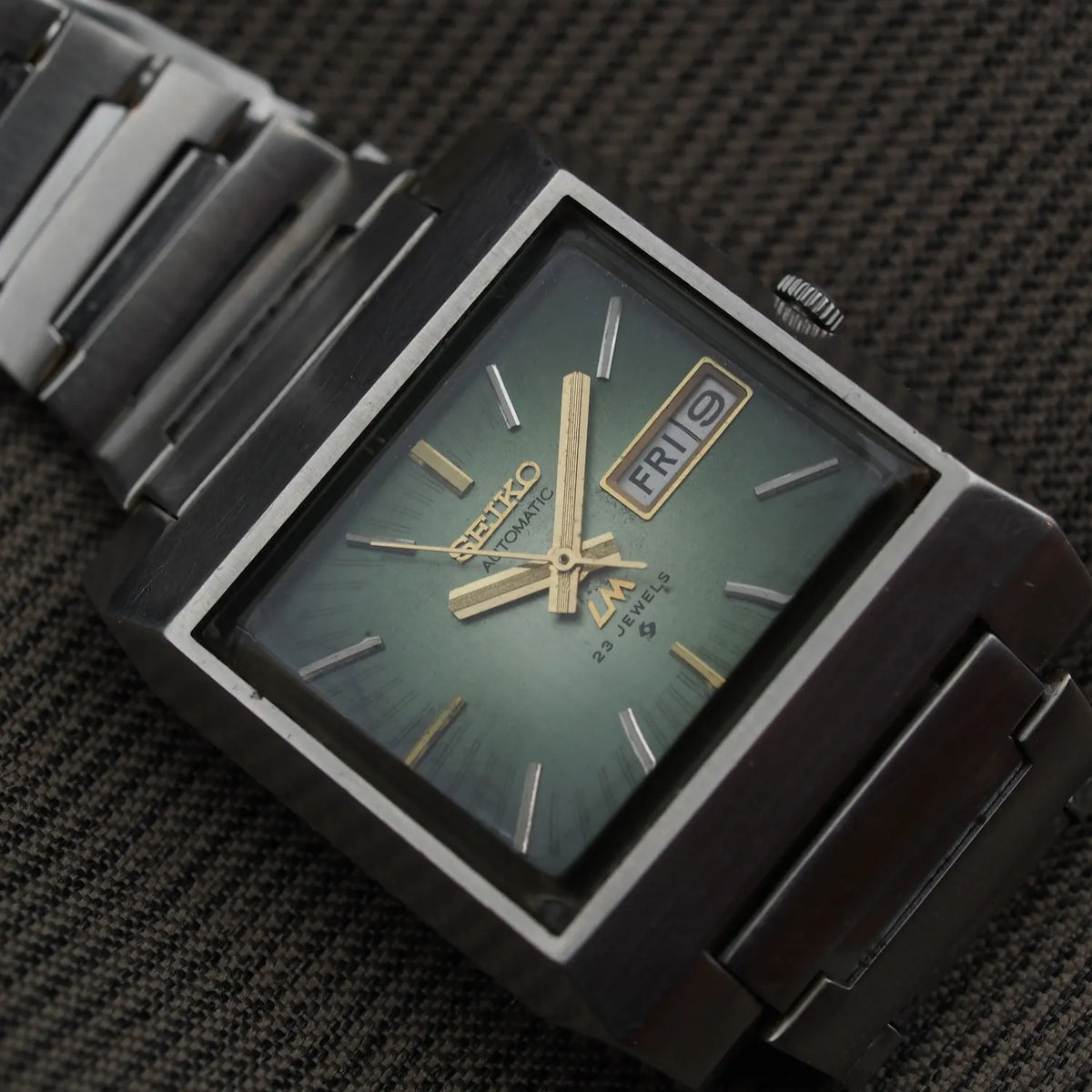
Vintage Seiko Watch Sizes: A Guide to 34–40 mm Cases
A 36 mm vintage Seiko can wear larger than a 38 mm example, and a compact 40 mm case can sometimes sit more comfortably than a smaller watch with long, straight lugs. Those are not contradictions: the number quoted in a product title is only one part of the fit. To choose a vintage Seiko intelligently, compare its case diameter with the distance from lug tip to lug tip, the case shape, bracelet or strap, and the way the dial occupies the front of the watch.
This guide concentrates on the particularly useful 34–40 mm range. It uses measurements from individual watches documented in the Vintage Watch Studio catalog, rather than pretending that every Seiko 5—or every model sharing a movement—has the same dimensions. The recorded measurements below describe the specific archived examples, not guaranteed specifications for all examples of those references.
What does a vintage Seiko's case size actually mean?
Case diameter is usually the width of the main case across its widest conventional dimension, excluding the crown. But an asymmetrical case, cushion profile, thick bezel or integrated bracelet can make this simple number misleading. Before comparing two listings, confirm what the seller has measured and whether protrusions are included. The dial opening may look large even when the steel case is relatively small.
Lug-to-lug measures the longitudinal span between the outermost upper and lower lug ends. It helps indicate how much wrist surface the watch occupies from top to bottom. Seiko's current specifications list diameter and lug-to-lug separately, precisely because they describe different dimensions. Lug width, by contrast, is the distance between the spring-bar attachments; it tells you what strap fits, not how long the watch wears.
Thickness, caseback shape and bracelet geometry also matter. A raised caseback can lift the case from the wrist, while a stiff first bracelet link may extend beyond the nominal lug-to-lug length. A curved lug may hug the wrist better than a straight one of the same measured length. There is no single wrist-circumference threshold at which a watch suddenly becomes 'too small'.
Real Seiko measurements: 34, 35, 36, 37, 38, 39 and 40 mm
The following figures come from specific Vintage Watch Studio watch records. Some entries are sold archive pieces; they remain useful reference points but are not offers of stock. These are case measurements, not movement diameters or a survey of all watches in each size class.
| Case | Documented VWS reference | Lug-to-lug | What the proportions suggest |
|---|---|---|---|
| 34 mm | Seiko Lord Matic 5606-5160 | 36 mm | Very short overall footprint in the archived example |
| 35 mm | Seiko 6602-8050, 1971 | 42 mm | Traditional small diameter, more extended lugs |
| 36 mm | Seiko 5 7009-3130, 1984 | 41 mm | Compact everyday mechanical proportions |
| 37 mm | Seiko 5 7009-3140, 1979 | 43 mm | A little more longitudinal presence |
| 38 mm | Seiko 5 6319-8100, 1977 | 42 mm | Broad face, relatively contained length |
| 39 mm | Seiko 5 6319-8020, 1977 | 40 mm | Unusually short listed length; verify measurement on the individual watch |
| 40 mm | Seiko Scuba 7N35-6000, 2003 | 44 mm | Sportier diameter with manageable documented span |
Notice the contrast between the 35 mm Seiko 6602-8050 and the 38 mm 6319-8100: both are recorded at 42 mm lug-to-lug. Their width differs by 3 mm, but their top-to-bottom reach does not. This is why numbers should be read together, alongside photographs. In particular, the archive's 39 mm / 40 mm 6319-8020 measurement deserves a fresh physical check before it is generalized to another specimen.
34–35 mm: small on paper, often substantial in character
Some vintage buyers have become accustomed to contemporary watches above 40 mm and assume that 34–35 mm must be a women's size. That is historically and stylistically misleading. Mid-century men's dress and everyday watches often favored compact cases, and a well-proportioned dial can be completely legible without a large metal footprint. Choosing such a Seiko is not accepting a 'lesser' watch; it is choosing a period-correct wearing experience.
The archived Seiko Lord Matic 5606-5160 is recorded at 34 mm in diameter and 36 mm lug-to-lug. Its short case profile is especially instructive when you compare it with a 35 mm Seiko 6602-8050 whose documented lug span is 42 mm. A single millimeter increase in diameter conceals a six-millimeter increase in nominal length. They cannot reasonably be assumed to fit alike.

If you are considering this size, inspect photographs on a wrist or beside a ruler. Check whether the crown extends far beyond the case, whether the lugs angle downward, and whether a replacement strap is narrow enough to preserve the watch's balanced look. Do not use a gender label as your only size filter: individual taste and wrist anatomy matter more.
36–37 mm: the adaptable vintage everyday range
For many people, 36–37 mm is a straightforward way to enjoy an authentic vintage Seiko without either a very small dress-watch look or an oversized modern sports profile. But the reference still matters. The 1984 Seiko 5 7009-3130 is documented at 36 by 41 mm, whereas the 1979 Seiko 5 7009-3140 measures 37 by 43 mm. Those cases share a movement family without sharing the same exterior dimensions.

In the 7009-3130 gallery, the textured dial, applied markers and integrated bracelet presentation can make the watch feel visually more prominent than a simple 36 mm statistic might imply. The bracelet can also affect how the watch actually meets the wrist. Original metal bracelets are often part of the appeal, but their remaining adjustment range and the behavior of their first links must be considered before buying.
If a slightly larger appearance is the aim, look at how much of the top surface is dial rather than bezel. A narrow bezel tends to expose more dial for a given outside diameter. This is a visual tendency, not a promise: color contrast, indices and crystal curvature also influence perceived size.
38–40 mm: broader dial, sportier presence and more variation
A 38 mm vintage Seiko does not necessarily wear like a modern diver. The Seiko 5 6319-8100 in the VWS archive is recorded at 38 mm wide but only 42 mm lug-to-lug. It has a larger nominal width than the 35 mm 6602-8050 yet the same reported span. Its broad cushion-like silhouette gives the dial a different presentation from a narrow round dress watch.

At 40 mm, the archived Seiko Scuba 7N35-6000 is recorded at 44 mm lug-to-lug. Its bezel and sports-case surfaces change the visual equation: some of the quoted diameter is occupied by bezel rather than dial opening. On a short wrist, 44 mm length may be more useful information than the 40 mm diameter alone.

Sports appearance does not establish water resistance. A decades-old Seiko Scuba may retain its historical rating on the case, but present-day sealing requires an appropriate condition assessment and testing. Similarly, the documented 40 mm Seiko Panda 6138-8020 chronograph stretches 46 mm lug-to-lug, offering a different kind of case presence from the 40 by 44 mm Scuba. A complication's dial and case thickness may accentuate the difference even further.
How to choose a size for your wrist without guessing
- Measure the wrist where you wear the watch. Circumference is helpful, but also consider the flatter usable surface across the top. Two wrists with the same circumference may have different shapes.
- Compare lug-to-lug with the wrist surface. Long straight lugs approaching or projecting beyond that surface may look and feel awkward. It is a fitting test, not a universal mathematical rule.
- Look at a straight-on photo and a side photograph. The former shows dial-to-case proportions; the latter reveals thickness, lug angle and caseback elevation.
- Ask for the bracelet fit range. Confirm removable links, clasp adjustment, stretch, end links and whether the first link pivots or extends rigidly past the lug.
- Compare a familiar watch you already own. If it fits, record both its diameter and lug-to-lug. A vintage Seiko with similar dimensions is a better starting point than an internet rule based on gender or wrist size.
- Confirm how the seller measured the watch. Unusual Seiko cushion, TV and integrated cases may be measured differently by different sellers.
For a first Seiko 5, a documented photograph-rich listing is particularly useful. Our Seiko 7009 reference guide explains the movement that appears in several of the compact examples above. It does not replace measuring the exact case: a shared caliber is not a shared wrist size.
Does smaller always mean more elegant—or less collectible?
Neither follows automatically. Some collectors prize slim 34 mm dress watches; others prefer the assertive lines of 1970s cushion cases or colorful chronographs. The rarity, originality, condition and exact reference of a watch have separate importance from its dimensions. Over-polishing or a mismatched dial does not become desirable just because a case happens to fall at a fashionable size.
Nor should size be used as a proxy for quality. A 36 mm Seiko 5 automatic and a 40 mm Seiko quartz diver solve very different wearing problems. Decide first what the watch is for: a tucked-under-a-cuff dress piece, casual daily use, a collectible sports design or a gift for someone whose wrist you cannot measure in person.
The VWS Seiko collection provides real photographed designs for comparison, including pieces retained as historical archives. Check each listing's measurements and current availability rather than assuming every pictured watch can be purchased immediately.
Frequently asked questions
Is a 36 mm vintage Seiko too small for a man?
Not inherently. Many period men's watches were made in compact diameters. Fit depends on the lug span, shape, dial proportions, wrist and style preference rather than a gender label.
Why can two 38 mm Seiko watches wear differently?
Their lug-to-lug lengths, thickness, bezel width, dial opening, case curvature and bracelets can differ even when both measure 38 mm across the main case.
Does lug width tell me how a watch fits?
Lug width primarily indicates the strap attachment width. Lug-to-lug is the top-to-bottom case length; the terms describe different measurements.
Can I rely on the historical measurements for every example of the same reference?
Use them as a guide, not a substitute for a seller's verified measurement. Listings may measure differently, and aftermarket components or integrated cases can complicate the comparison.
Should a vintage Seiko's lugs overhang the wrist?
Many people prefer them to stay within the flatter wrist surface, especially with rigid bracelets. Comfort, personal preference and actual try-on matter more than a fixed rule.
The most useful size is the one that fits. Start with diameter, verify the lug span and bracelet geometry, then decide whether the actual photographed Seiko looks and feels right to you. That approach is more reliable than making a decision from one millimeter number—or from a modern size trend.






