What Is a Vintage Watch? Age, Characteristics and Examples
A watch can be fifty years old and look surprisingly modern. Another can leave the factory this year with a domed crystal, a small case and an aged-looking dial. Only the first is vintage in the historical sense. The second is a modern watch with vintage-inspired design. That distinction sounds simple until someone asks the harder question: exactly how old must a wristwatch be before it is “vintage”?
There is no single universally enforced age threshold in the watch trade. Some dealers use twenty years; others favor thirty or more, and collectors often use neo-vintage for watches occupying the boundary between recent production and established historical eras. A more useful definition connects when a watch was actually made with the design, technology and manufacturing context of its period.
What does “vintage watch” mean?
A vintage watch is an older, period-made watch considered within the historical context of watchmaking and collecting. Its relevance is not determined solely by a faded dial or a mechanical movement. A quartz wristwatch produced during the first generations of widespread quartz adoption can be vintage. A hand-wound wristwatch produced today is not automatically vintage just because its operation is traditional.
The term is a collecting and retail convention, not a globally standardized classification with a single legal definition. Chrono24's buying guide explicitly notes that no exact cutoff governs the term and uses the 1990s and earlier as a broad rule of thumb. Another Chrono24 comparison describes more-than-thirty-year-old watches as often considered vintage. Even reasonable specialist sources draw the line somewhat differently. Treat a seller's age label as a description to examine, not an independent proof.
The simple working definition
For practical browsing, a watch around thirty years old or older is commonly a plausible vintage candidate, while examples from roughly the past twenty to forty years may also be described as neo-vintage. This is a useful convention, not a rule that makes a 1996 watch vintage and a 1997 watch definitively non-vintage. The boundaries move with the calendar and differ by collector community, model and market. Ask the more informative question: Which period was this particular watch manufactured in, and what makes it characteristic of that period?
Vintage, antique, neo-vintage, pre-owned and retro are not synonyms
| Label | What it normally describes | Important limitation |
|---|---|---|
| Vintage | An older watch made in an earlier historical period | No universal minimum age |
| Neo-vintage | A relatively recent historical generation, often late twentieth century into early twenty-first | Date range differs by collector and publication |
| Antique | A substantially older object, sometimes using a century-scale convention | Watch collectors and legal contexts may use the term differently |
| Pre-owned or used | A watch previously sold or owned | Says nothing definite about manufacturing date |
| Vintage-inspired, retro or heritage reissue | A modern watch with historical styling or revived model cues | A reproduction of a design is not the original period watch |
| New old stock (NOS) | Older unsold inventory presented as unused | Requires evidence of condition and history; unused is not the same as unrestored |
The important separation is age versus ownership history. A five-year-old used smartwatch can be pre-owned but is not meaningfully a vintage wristwatch. A seventy-year-old watch kept in a drawer may have had very little wear, yet it is still historically old. An unused watch can have aged lubricants and gaskets despite excellent cosmetic condition.
Why the term “neo-vintage” is flexible
Collectors use neo-vintage to discuss watches that combine older design language with more contemporary production, such as late 1980s, 1990s and some early 2000s pieces. A 2026 Chrono24 collector article places a rough neo-vintage zone at 20–40 years and an older vintage zone at approximately 45–75 years. That is one editorial convention, not a hard dividing line that every market accepts. An individual 1990s watch can legitimately appear under both descriptive labels depending on context.
Why the production era matters more than the styling
An earlier watch is a physical record of its manufacturing choices: the movement technology available at the time, the proportions popular with its buyers, materials, dial construction, and the reference system used by its maker. A contemporary homage may reproduce several of these cues yet have modern parts, standards and service expectations. That does not make the new watch inferior; it means it tells a different historical story.
Consider a slim mechanical dress watch from the 1960s and a new dress watch with a similar dial. Both can use a hand-wound movement, simple baton markers and a leather strap. The vintage example may have an older case architecture, movement family and manufacturer-specific reference code. The new example was produced under a different supply chain and technical environment. Style resemblance is the beginning of the comparison, not proof of equivalent age or historical status.
Design clues are useful, but none dates a watch alone
Smaller case sizes, acrylic crystals, narrow lugs, integrated bracelets, colorful 1970s dials or sharply geometric 1980s cases can offer period context. So can typography, logo versions, day/date layouts, luminous markers, chronograph registers and crown shapes. But makers changed designs gradually, reused patterns, sold regional variants and revived older ideas. Treat any visual clue as a hypothesis to test using model references, markings, catalogs and documented examples—not as a factory date stamp.

Watchmaking eras in real objects
A useful perspective from the VWS archive: the October 2026 Shopify snapshot recorded 282 watches attributed to the 1970s, 129 to the 1980s and 105 to the 1960s. These counts describe which eras happened to be represented in one dealer’s catalog—not relative production volumes or the popularity of those decades around the world. Dating for individual watches still needs reference-specific verification.
Rather than a universal “vintage look,” the gallery of historical wristwatches offers multiple design and technical traditions. These examples are documented VWS product records. Their years are catalog descriptions unless the underlying year has been separately authenticated from factory records; they are not newly asserted factory-certificate dates.
1940s: compact hand-wound watches and utilitarian layouts
The archived Mido Multifort Limited catalogued as 1940 has a compact stainless-steel case, a black dial, luminous numerals, a red 13–24-hour scale and small seconds. The signed manual-wind movement is separately photographed. These tangible features are relevant to understanding a period watch, but a military-style dial does not, by itself, establish military issuance or provenance.

1960s: varied mechanical dress-watch proportions
A 1966 Omega Seamaster 600, reference 136.011, provides a different example: an understated round case, applied dial details, a date display and a documented caliber 611. The gallery includes the movement and interior reference. The manufacturing period is meaningful partly because the case and movement can be studied together; a similar modern watch would not become a 1960s object merely by copying the dial.
1970s: more expressive cases alongside familiar dress watches
The 1977 Seiko 5 6319-8100 shows a blue striped dial and automatic day-date format. Many 1970s watches introduced bolder case and dial ideas, but simple dress watches also continued to be sold. One decade contains numerous aesthetics. The distinction between a period-made watch and a later “seventies-style” reinterpretation depends on production evidence, not the color palette alone.

1980s: quartz and integrated-design ideas belong to vintage history
The Cartier Must de Cartier 21 reference 9010, catalogued as 1989, demonstrates why quartz does not disqualify a vintage watch. Its Roman-numeral bezel, bracelet design and quartz movement reflect a very different era from the Mido's manual-wind construction. Mechanical versus quartz is a choice of timekeeping system, not a universal measure of collectibility or historical age.

1990s and early 2000s: the moving boundary
The Seiko 5 7S26-0570 recorded as 2001 illustrates a boundary case. In 2026 it is approximately twenty-five years old if the recorded year is correct. Some stores call this vintage; another collector may prefer neo-vintage. Neither term can replace verification of the actual reference and period. What matters for a buyer is whether the manufacturing story, condition, components and service expectations have been explained accurately.

Mechanical, quartz and digital watches can all be vintage
A watch's power source does not determine its age classification. Manual-wind and automatic movements dominated many earlier wristwatch generations, but quartz became historically important in the late twentieth century. Seiko records that the Quartz Astron 35SQ went on sale on December 25, 1969. Its commercial launch is an important boundary in wristwatch technology—not the date on which vintage watches suddenly stopped being mechanical.
During the 1970s and 1980s, quartz and digital watches were not imitation vintage objects; they were contemporary technology. Today, surviving examples may be historical collectibles. They can also demand different repair expertise. An older electronic circuit, display or proprietary module may be difficult to replace even if its battery is inexpensive. A mechanical watch may have repairable conventional components but still require specialist parts and skilled work. Historical significance, serviceability and resale value are three separate questions.
A modern mechanical watch is not necessarily “older in spirit” than a vintage quartz
It is tempting to equate gears with heritage. That is too narrow. An early quartz watch can document a period of innovation just as a manually wound watch documents a different movement tradition. For collectors who care about an era, contemporary production technology of that era is itself historically interesting. Choose the format for the experience you want rather than using movement type as a substitute for dating.
How do you establish that a watch was made in the claimed period?
A model name may run for decades. A brand logo can change and later return. A serial number may date a movement, a case, or nothing reliable without a manufacturer's reference data. Start with the complete case reference, the movement caliber, the specific serial marking where applicable and the relevant manufacturer or period-catalog documentation. These identifiers are not interchangeable.
The Seiko family provides a useful narrowly defined example: on many models 6319-8100 is a caliber–case designation, whereas a separate serial may help constrain a production period. Our Seiko caseback-code reference explains this brand-specific convention. Do not transfer Seiko's decoding rules to Longines, Omega, Cartier or every earlier Japanese watch.
For a Longines, the manufacturer offers an archive-extract service based on historical records. Crucially, Longines states that an extract is not an authentication certificate for the complete watch or its parts. The document can add historical evidence while leaving the present physical condition to be evaluated separately. Other makers use different record systems, and some may have no accessible archive for a particular model.
Estimate date confidence honestly
Use wording proportional to the evidence: “catalogued as 1977,” “reference consistent with late-1970s production,” and “manufacturer archive identifies delivery in a stated year” are different levels of certainty. A sale date on a receipt may differ from manufacturing date. A serviced watch may contain later components. If only general styling has been checked, do not present an exact production month or birth-year claim.
Does vintage automatically mean rare, valuable or better made?
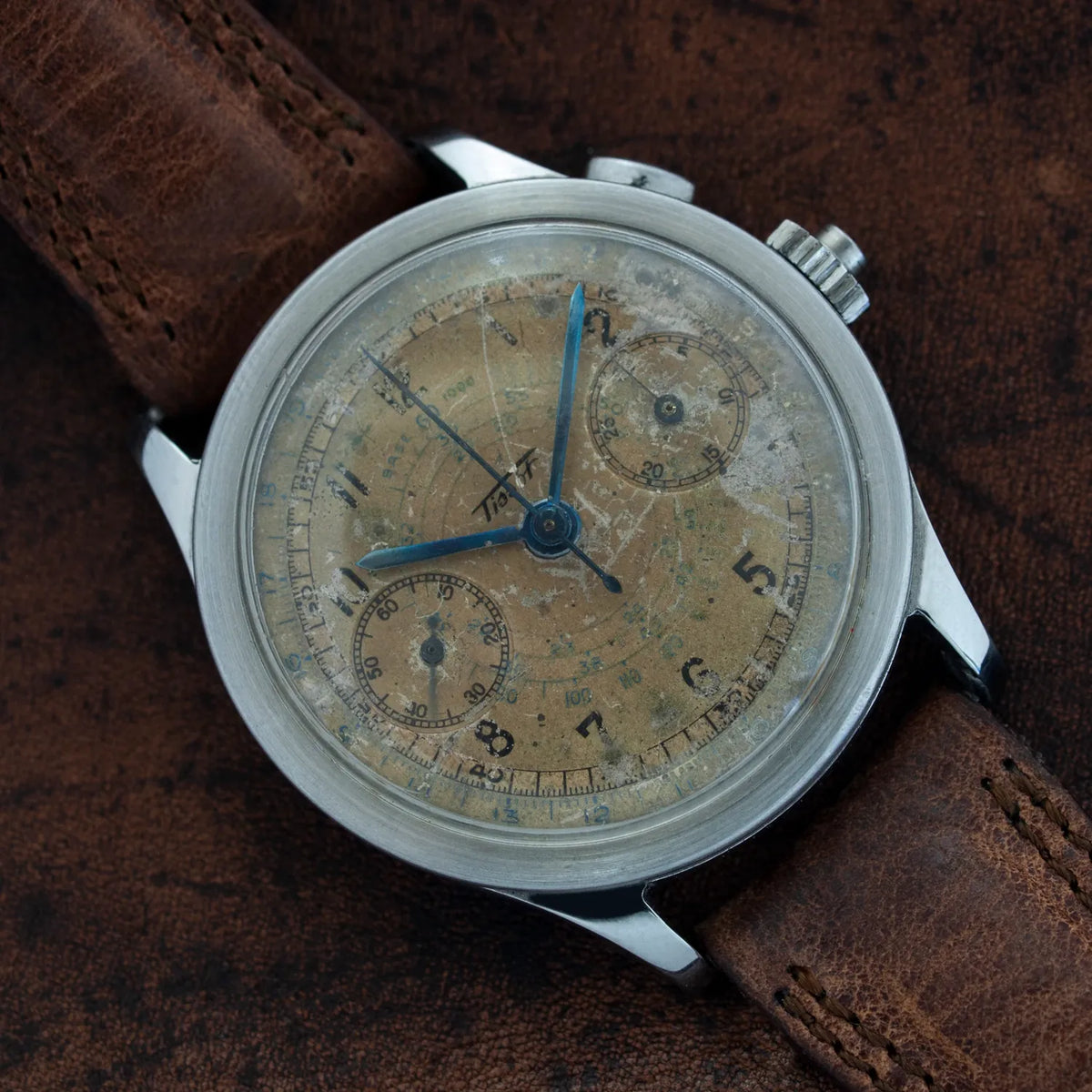
No. A watch can be old and common, unusual and inexpensive, or historically important but technically compromised. Production volume, survival rates, demand, condition, provenance and originality matter, but they cannot be inferred from the adjective “vintage.” A scratched original dial can be desirable to one collector and unacceptable to another; a freshly restored dial can be attractive while reducing period originality. Neither is universally “better” without defining the buyer's priorities.
A useful vintage listing should explain specific watch facts instead of making age do all the selling. Look for clear photographs, reference details, a disclosed condition assessment, known service history, and transparent descriptions of replacements. A dated caseback inscription or familiar model nickname does not independently prove a watch is rare or completely original. For a first purchase, the practical match between the watch and the owner's wearing habits is often more important than placing the model in an ever narrower vintage subcategory.
Buying an old watch means buying its present condition as well
A watch made forty or eighty years ago can have a recently serviced movement and an aged original dial; another of the same reference can have a replacement movement or neglected seals. The age label tells you neither which condition applies nor whether it is safe to swim with. Even if a vintage case displays a historical water-resistance rating, the present seals and construction must be evaluated and tested appropriately. Do not treat “vintage” as a warranty of reliability or as an excuse for undisclosed faults.
Similarly, an old mechanical watch may run acceptably yet require preventive servicing, while a quartz model may appear to work but have hidden battery leakage or scarce electronic components. Ask for operational information and the scope of any seller warranty separately from the date. Maintenance is an ownership consideration, not part of the definition itself.
Historical age, identity and purchase suitability are related but distinct. For a more focused next step, read how to identify the caseback, serial and movement and how vintage and modern watches compare.
Frequently asked questions
Is a 20-year-old watch vintage?
Some dealers would call it vintage; many collectors would call it neo-vintage or simply older pre-owned. There is no single binding age cutoff. Identify the actual production period and the seller's intended meaning.
Is a 30-year-old watch vintage?
Thirty years is a common rule of thumb and a reasonable candidate for a vintage description. It is not a certificate of originality or a guarantee of market value.
Are 1990s watches vintage?
Often yes, although neo-vintage is also widely used. The model and collecting community influence the label. Exact manufacture and historical configuration matter more than the label.
Can a quartz watch be vintage?
Yes. Quartz wristwatches have been commercially available since 1969, and surviving 1970s–1990s models represent important chapters of watchmaking history.
Is a vintage-inspired new watch an authentic vintage watch?
It can be an authentic modern product with vintage-inspired styling; it is not an original watch produced in the earlier era it evokes. Look for a clearly stated manufacture date and reference.
Does vintage mean a watch is collectible or expensive?
No. Age is one part of historical context. Demand, originality, scarcity, condition and functioning vary greatly from watch to watch.
The most helpful definition is not a magic number. A vintage watch is a genuine product of an earlier watchmaking period, understood through its own design and construction, and identified as accurately as the evidence permits. Explore the Vintage Watch Studio archive and available watches with that perspective: start with the watch itself, not the label on the category page.