
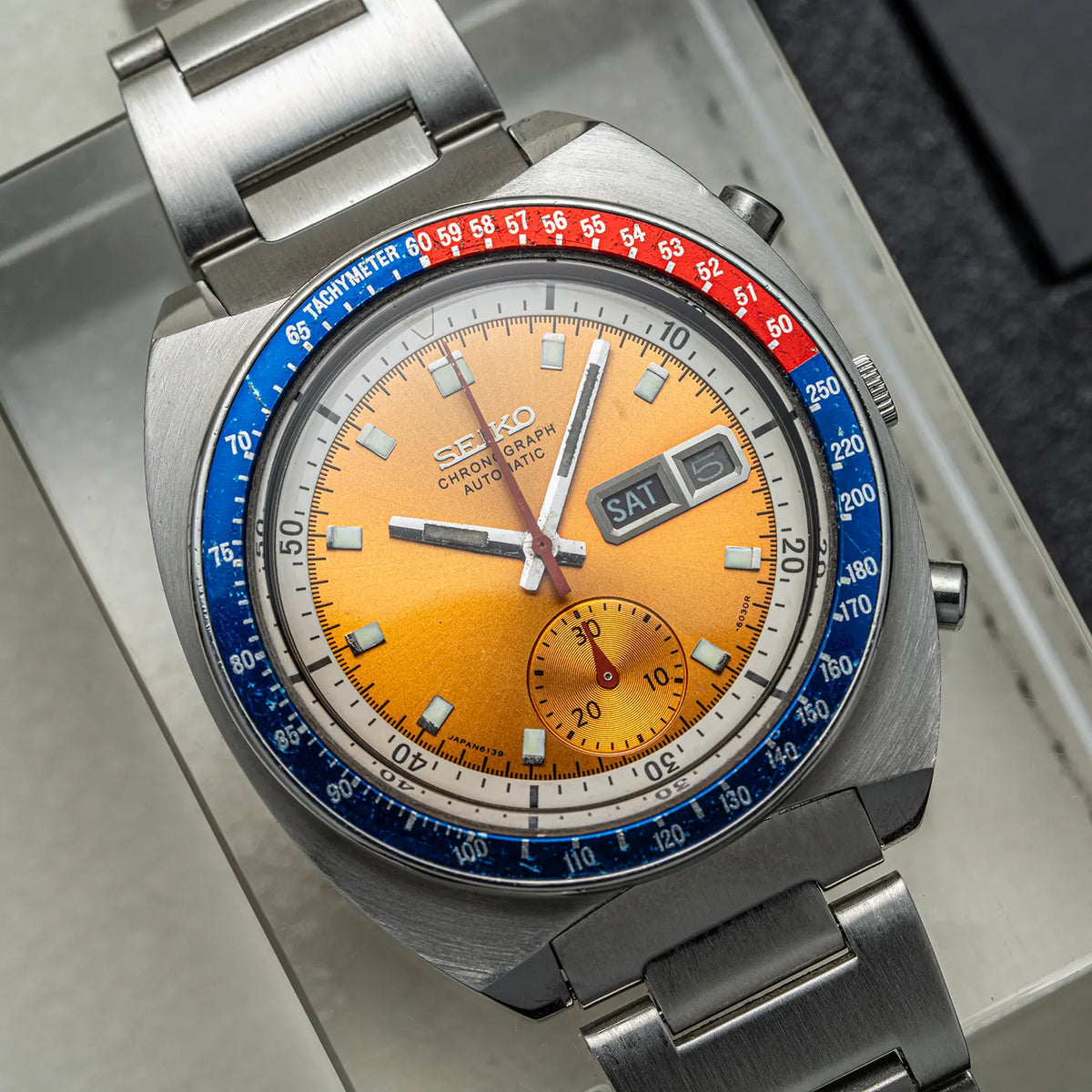
Seiko 6139 Pogue: Models and Variations
The Seiko “Pogue” is the yellow-dial 6139-600x automatic chronograph, named after astronaut William R. Pogue, who wore a privately bought Seiko 6139 during the Skylab 4 mission in 1973–74. Today the nickname covers a whole family of watches, and the details inside that family are where originality and value are decided.
The short version: the watch Pogue actually wore is documented by collectors as the 6139-6005, the version sold in the United States. The 6139-6002, sold in other markets, looks almost identical and is routinely called a Pogue as well. This guide explains how the two relate, which other 6139 references are not Pogues, and what to check before buying one.
Quick answers
- What is a Pogue? A yellow-dial Seiko 6139-600x chronograph with a red-and-blue “Pepsi” tachymeter bezel.
- Which reference did Pogue wear? Collector research points to the 6139-6005 (US market). His case code was never recorded in the original auction listing, which only said “6139-600x”.
- What is the 6139-6002? The same design sold in other markets. Widely called a Pogue, but it is the sibling, not the documented flown reference.
- Movement: Seiko caliber 6139, automatic, column wheel and vertical clutch, 21,600 vph, introduced in 1969.
- Is every 6139 a Pogue? No. The 6139 movement powered many other case and dial designs.

6139-6005 vs 6139-6002: how the Pogue family fits together
The 6139 is the movement. The 600x numbers identify a related group of case and dial configurations. Collector documentation separates them mainly by market:
| 6139-6005 | 6139-6002 | |
|---|---|---|
| Market | United States / export | International and Asian markets |
| Production (collector research) | Roughly 1971–1973 | From about 1971, with several dial variants over the decade |
| Link to Pogue | The reference collectors identify as the watch he wore | Same design and look; called “Pogue” by extension |
| Documented dial colours | Yellow | Yellow, blue and black |
Collector sources disagree on some dial codes and dates, so treat the table as orientation rather than a rulebook. What matters in practice is that “Pogue” in a listing can mean three different things: a yellow-dial 6139-600x in the broad collector sense, a 6139-6002, or a 6139-6005. Ask which one the seller means, and ask for the caseback reference.
Why one watch became a nickname: Pogue and Skylab 4
William Pogue flew on Skylab 4, the third and final crewed Skylab mission, from November 1973 to February 1974. He wore a Seiko 6139 that he had reportedly bought himself at a US military exchange. It was never approved by NASA, and he carried it alongside the Omega Speedmaster the agency issued. The Seiko is frequently described as the first automatic chronograph worn in space.
The two watches should not be confused. The Smithsonian National Air and Space Museum documents the Omega Speedmaster NASA issued to Pogue for Skylab 4, transferred to the museum in 1977. That record is about the Omega. The Seiko's story comes from collector research and Pogue's own confirmation that it was a yellow-dial 6139. His Seiko later went to a 2008 charity auction, where it was listed simply as a “6139-600x”. The 6139-6005 identification rests on the dial type and the US-market production window, not on a recorded case code.
That makes the story stronger, not weaker: an affordable Japanese automatic chronograph, bought off a base shelf, worn on a space station. There is no need to invent a NASA endorsement.
Caliber 6139: why the movement matters
Seiko introduced the 6139 in 1969, in the first generation of automatic chronographs. Its two defining features are a column wheel, which coordinates start, stop and reset, and a vertical clutch, which connects the chronograph to the going train without the hand jumping when the timer starts. Which brand was “first” to market in 1969 depends on whether you count announcement, delivery or documented sale. The 6139's column-wheel and vertical-clutch design is not in dispute.
| Feature | Seiko 6139 (Pogue-type watches) |
|---|---|
| Revisions | 6139A (about 1969–1971), 6139B (about 1971–1978); a watch dated 1977 belongs to the B period |
| Type | Mechanical, automatic chronograph, no hand winding |
| Chronograph architecture | Column wheel and vertical clutch |
| Beat rate | 21,600 vibrations per hour (3 Hz) |
| Jewels | 17 according to collector reference tables; confirm against the Seiko parts sheet for the exact revision |
| Dimensions | 27 mm diameter, about 7.1 mm thick |
| Displays | Hours, minutes, central chronograph seconds, 30-minute counter at 6, day and date |
| Calendar | Day and date corrected through the recessed crown at different press depths |
On the dial, the 6139 works differently from a three-register chronograph. The red central hand counts elapsed seconds, the single subdial at 6 o'clock counts elapsed minutes up to 30, and there is no chronograph hours register. Time is read from the main hour and minute hands, and the day-date sits at 3.
Design variations: yellow, black and other 6139 references
Yellow-dial 6139-6002
The classic Pogue look pairs a yellow-orange sunburst dial with a red-and-blue outer tachymeter bezel and a white inner timing scale. On the VWS example, applied rectangular luminous indexes, luminous hour and minute hands and a red-brown chronograph hand complete the layout. Yellow pigment ages in uneven ways and bezel inserts fade, which is normal. What you are looking for is wear that looks consistent across dial, hands, bezel and case, not a single component that looks brand new.
Black-dial 6139-6002
VWS has also documented two sold black-dial 6002s, from 1977 and 1974. Same case reference, very different character. Sellers sometimes call these Pogues, but collectors reserve the strongest association for the yellow dial. A black dial is not a sign of a fake, and it is not the configuration tied to the Skylab story.


6139-6012, 6139-7080 and other 6139s
The 1971 6139-6012 uses the same movement in a different case and dial design, and the angular 6139-7080 is another example. Nicknames describe appearance. The stamped reference is what identifies the watch. A period-correct 6139 chronograph is not automatically a Pogue, and a 6002 case with replacement parts does not become original because the movement runs.

Buying a Pogue: what to check
Dial and hands
- Typical yellow-dial layout: applied Seiko logo, “Chronograph Automatic” printed above the centre, “Water 70m Resist” printed along the 9 o'clock side, day-date at 3, single subdial at 6.
- Printing should be sharp but not glossy or unusually thick. Over-crisp lettering on an otherwise aged dial is a refinish warning sign.
- The red chronograph hand, subdial hand and luminous hands should age at the same rate as the lume on the indexes.
Bezel and inner scale
- The red-and-blue insert is exposed to knocks and sunlight, so some fading is expected. Look for mismatched colours, damaged numerals or misalignment.
- Check whether the inner ring is meant to rotate on that watch. The VWS example has a fixed inner bezel, and the listing says so.
Case and reference
- The case is about 41 mm across and 46 mm lug to lug, with a 19 mm lug width, so it wears larger than the number suggests because the bezel is broad.
- Over-polishing softens the angled shoulders and the brushed top surfaces. Deep pusher damage or corrosion around the stem or caseback is worth asking about.
- Ask for a photo of the caseback reference. It should match what the seller says about the watch (6002 or 6005), and should not be used alone to infer the manufacturing year. Our guide to Seiko serial numbers explains what a serial can and cannot tell you.
Chronograph function and service
- Start, stop and reset should be smooth. The central hand must return exactly to zero, and the 30-minute counter must reset too.
- Calendar quickset should work without force. Do not press a sticky pusher repeatedly on an unserviced watch.
- A service record and a measured rate (for example, “+2 sec/day on the timegrapher”) say more than “runs perfectly”.
Bracelet
Many surviving 6139s now sit on replacement bracelets or straps. If an original bracelet matters to you, ask for photos of the underside, the end links and the clasp. The VWS example comes with its original full-length Seiko bracelet.
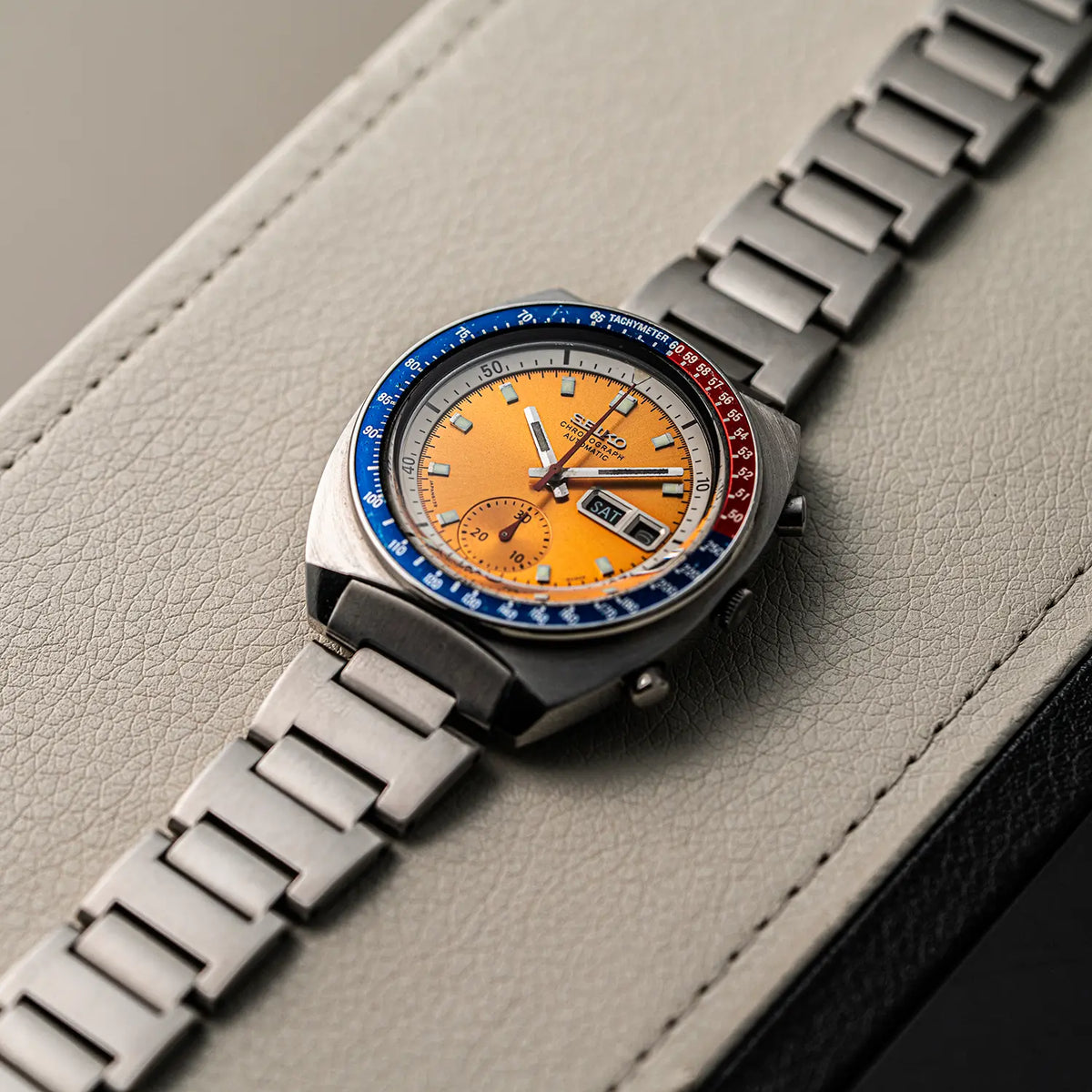
Photos to request from any seller
- Dial and bezel straight on, in neutral light
- Case profile and both pushers
- Caseback with the stamped reference
- Bracelet underside, end links and clasp
- A short video of start, stop and reset
Wearing it and water resistance
A serviced 6139 is a wearable watch, and it is also nearly fifty years old. The dial says “Water 70m Resist”, but that was a 1970s marking. Seals, pushers, crown and crystal have aged since, so do not swim with it or operate the pushers in water unless a watchmaker has pressure-tested that exact watch.
How to read the word “Pogue” in a listing
Use the nickname as shorthand, not as proof. A trustworthy description starts with Seiko + full reference + confirmed movement + documented condition, and only then the nickname. If a listing says “Pogue” but gives no caseback reference, replaced parts are a real possibility. If it implies the watch flew on Skylab, ask for evidence.
To compare more watches, see all vintage Seiko chronographs, the wider Seiko collection, or other 1970s watches. If you are looking for a particular 6139 reference and it is not in stock, send us a message and we will tell you when one arrives. Sold archive pieces are shown here as documentary references, not offers.
Related guides
- Seiko Serial Numbers Explained
- Seiko Caliber 7A38: Quartz Chronograph Movement Guide
- Seiko Caliber 7A48: Quartz Chronograph Movement Guide
- Seiko Caliber 7T92: Quartz Chronograph Movement Guide
Seiko Pogue FAQ
Which is the real Pogue: 6139-6002 or 6139-6005?
Collector research identifies the 6139-6005 (US market) as the reference Pogue wore. The 6139-6002 is its international sibling with the same look. Both are commonly called Pogues, and a 6002 is a good, honest example of the design.
Is every Seiko 6139 a Pogue?
No. Caliber 6139 powered many case and dial families. The Pogue name belongs to the yellow-dial 6139-600x chronographs, and the 6005 has the strongest claim.
Did NASA issue Pogue a Seiko?
No. NASA issued him an Omega Speedmaster, now documented by the Smithsonian. The Seiko was his own watch and was not NASA-approved.
Is a black-dial 6139-6002 original?
It can be. Black-dial 6002s are documented, including two in the VWS archive. Whether one dial is original still depends on inspecting that watch against period examples.
Can I wear a Seiko Pogue every day?
A properly serviced one can be worn regularly. Judge chronograph function, timekeeping and condition on the individual watch, and keep it away from water.
How many jewels does the 6139 have?
Collector tables list 17 jewels for the 6139A and 6139B used in Pogue-type watches. Confirm the exact revision in the watch you are considering.
Sources
- Smithsonian National Air and Space Museum, Chronograph, Pogue, Skylab 4 (the Omega Speedmaster issued to Pogue)
- Plus9time, The true Seiko Pogue Chronograph – 6139-6005 (collector research on Pogue's reference and the 2008 auction)






